 SQUADGOD Back to Blog
Soccer Formations Every Youth Coach Needs (And How to Teach Them)
A practical, tactical breakdown of the most common grassroots soccer formations for 7v7, 9v9 and 11v11 — the pros, the cons, and how to teach each one. Plus how to plot any formation visually and share it with your squad before matchday.
The right formation isn't about winning — it's about development. Here's a breakdown of the best grassroots soccer formations for 7v7, 9v9 and 11v11, with the pros and cons of each. Then use SquadGod's drag & drop lineup builder to plot your starting XI, set your subs bench, and share the visual team sheet with players before kick-off.
Why Formation Matters at Grassroots Level
At the grassroots level, a formation isn't a tactical masterplan — it's a teaching tool. The shape you pick tells young players where to stand, what their job is, and how their role connects to the rest of the team. Get it right and players develop positional sense that lasts a lifetime. Get it wrong and you end up with ten kids chasing the ball in a swarm.
The key is choosing a formation that suits the number of players on the pitch — and that evolves with them as they move from 7v7 to 9v9 to the full 11v11 game.
7v7 Formations
7v7 setup
Two defenders and a midfield three gives every player a clear role. Great for teaching width and positional discipline at a young age.
Can leave the lone striker isolated if the midfield doesn't push up.
7v7 setup
A solid defensive base of three lets young players feel secure and learn to build from the back.
Less natural width in midfield — wingers have to do a lot of running.
7v7 setup
Attacking-minded setup that encourages possession and forward play.
A single defender can be exposed on the counter — needs a confident, vocal player there.
9v9 Formations
9v9 setup
Balanced and simple — three at the back, three in midfield, two up top. Easy for young players to understand their position.
Midfield can get overrun if the wide players don't tuck in defensively.
9v9 setup
A flat midfield four teaches shape and width, mirroring what players will see at 11v11.
Only two defenders — risky against fast counter-attacking teams.
9v9 setup
Plenty of attacking options and a defensive three for stability. A great all-rounder for development.
The two central midfielders cover a lot of ground — needs fit, disciplined players.
11v11 Formations
11v11 setup
The classic. Simple, balanced, and every grassroots player understands it. Two strikers means plenty of goal threat.
The midfield four can be bypassed by teams playing a narrow three in the middle.
11v11 setup
A midfield three dominates possession and a front three offers width and attacking variety. The modern default.
Wingers have to track back — demands high work rate and tactical awareness.
11v11 setup
Wing-backs provide width while a back three stays solid. Great for teams with athletic wide players.
Wing-backs are the key — if they don't get up and down, the system falls apart.
11v11 setup
A defensive shield of two, a creative three behind a lone striker. Flexible and hard to beat.
Can be too defensive if the attacking three don't join the striker quickly enough.
How to Teach a New Formation to Young Players
- 1Start with positions, not tactics. Walk each player to their spot on the pitch and explain their area of responsibility.
- 2Use a visual team sheet they can see before training — players learn the shape faster when they can picture it.
- 3Run shadow play (no opposition) so players can rehearse movement and spacing without the pressure of a game.
- 4Coach the transitions — what happens when you lose the ball, when you win it, when the play shifts from one side to the other.
- 5Keep it simple. One formation per season at young ages is plenty; mastery beats variety for development.
Plot Any Formation with SquadGod's Lineup Builder
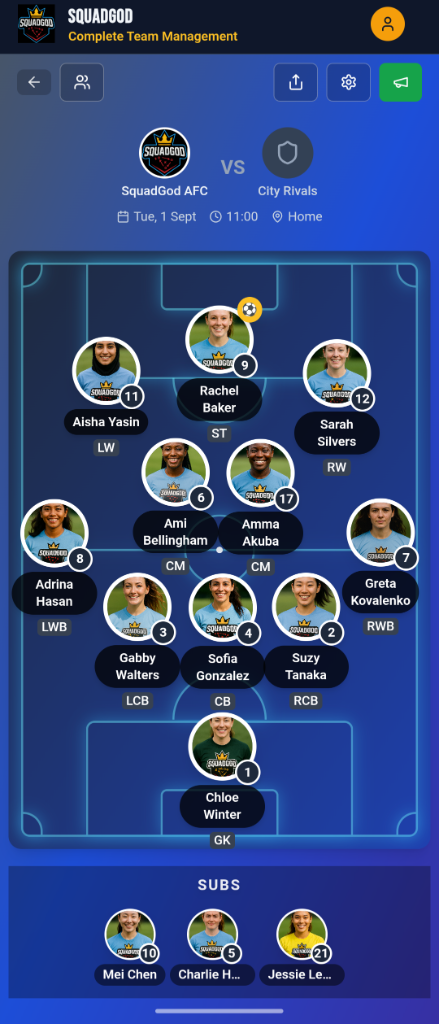
Reading about formations is one thing. Seeing your actual players in the shape is another. SquadGod's drag & drop lineup builder lets you plot any of these formations — 2-3-1, 3-3-2, 4-4-2, 4-3-3, anything you like — on a virtual pitch, with your real squad.
Drag players into position, set your substitutes bench, choose your pitch theme, and share the finished visual team sheet directly with your players and parents before matchday. They arrive knowing the shape, their position, and what's expected of them — so warm-up is about football, not about explaining where everyone stands.
- →Drag & drop real players onto a live pitch
- →Set your starting XI and a full substitutes bench
- →Save and reuse formations week after week
- →Share the visual team sheet with players and parents before kick-off
Build Your First Team Sheet Today
Stop explaining formations with a whiteboard and a marker pen. Plot them visually, share them instantly, and let your players turn up knowing the plan.
No credit card required • Lineup builder included on the free plan
Keep Reading
Football Lineup Builder: Create Your Starting XI with Subs
Drag real players onto a live pitch, set your formation, and share your team sheet.
Read moreFA 2026/27 Grassroots Football Changes: What Coaches & Parents Need to Know
The FA's new Youth Development Framework — format changes, heading rules, and how to adapt your team.
Read moreData-Driven Team Selection: How Tracking Stats Makes Selections Fairer
Objective data to pick fairer, stronger squads every week.
Read more